Dealing with Dead Air, Revisited
Hail beautiful Bards! Last year, we released a video talking all about “dead air” at the table, and how to deal with it. It can be easy to get that sinking feeling when suddenly players are going quiet, and as a DM we’re running out of immediate ideas. I know that the world of TTRPG’s is full of people who, like me, are maybe on the introverted side, and in one way or another may fear this sense of awkwardness. For many of us, that’s exactly one of the things we look to games like these for, to tell stories we wouldn’t or couldn’t on our own, to take on the mask of characters who are varying levels of similar or different from us irl. But inevitably, we stumble, we run into blocks, and we encounter periods of pause.
Luckily, it’s still just a game after all! So in this handy dandy blog, we’ll be listing out our tips we compiled in our aforementioned video, as well as some reflections that have dawned since its release.
Go easy on yourself!
For starters, go easy on yourself! Even with all of the tips in the world, dead air may happen, and it may not. It’s an occupational hazard for DMs, and it’s impossible to prepare for every scenario your players could think of. If it does happen, take a breath, and when you’re ready, keep going. Your players most likely don’t even see it the same way as you, because they don’t feel the pressure of having the weight of the entire story on their shoulders. Don’t forget, DnD is a group activity, and everyone is there to tell the story together. What seems like forever to you could very well be an extended dramatic pause in their eyes, or maybe the perfect opportunity for them to step in. Also, just as a bonus tip, as much as we all love the professional actual plays, remember that 99% of our games are not that - we don’t have the leisure of cutting the dead air moments and having a professional production team. You’re doing great, and you don’t need to put that kind of pressure on yourself.

Chase the moment up a tree, set it on fire
This next tip is inspired by one of OG DnD creators, Matthew Colville. He said that engaging players is like “chasing them up a tree, and then lighting that tree on fire.” This is one of the keys for minimizing dead air, because we need to understand that PC’s very often do not contain internal motivation. They are prompted to action via events in your world, and ideally, those are events that you have planned and given clear escape routes for. If you back your players into a corner, you just have to wait for them to choose from their limited choices. Some of my favorite ways to do that are to:
A) remember that the world will continue with or without the players, and eventually that will lead back to them, whether they like it or not; and
B) taking action as an NPC with specific desires. What do they want, and how will they get it?
With tools like these, we return the ball to the players’ court, and likely lead them to where we plan the story to go.
Utilize audio to fill in the gaps
For this tip, we’re a little biased, but bringing audio to the table really helps cover up that awkward silence. There’s so much utility that you can get out of ambience, music, and sound effects, but one strategy, which is also conveniently the easiest, is to set a bed of sound. That base layer of noise brings the world to life, but it also allows you to take more space, as it catches the what-would-be silence and diffuses it into an immersive worldscape. The audio is able to embody the setting, and can tell part of the story even without active narration. It means that you can lean on the sounds to create breathing room, as well as cue inspiration for yourself, pointing you toward imagery and descriptions to conjure. Having an audio solution like Pocket Bard is a surefire way to alleviate the stress of dead air, and elevate your game’s immersion all around.

Empower your players to take space
Now, when it comes to your story living and breathing, there’s no greater tool than relying on your writing team: your players. Again, they’re your collaborators, and everyone at the table wants the story to be great. In terms of utilizing them to help prevent dead air, think of it as empowering your players to take space. Your players should know that they have the agency to take part in crafting the narrative, and it’s everyone’s job at the table to create that room, and to turn it into a habit. Some great ways to establish this are to directly ask a player a question. After describing a scenario, take a short pause, and then point a question at a player character. What are they thinking? What do they smell? What memory comes to mind for them? For bonus points, you can sparingly introduce the scenario with a question. Who answers the loud knocking at the door? How do you react to the wet drop of slobber falling on your shoulder? Prompting your players to action is a fantastic way to develop their instincts for demonstrating their ability to take the story for brief moments, through their characters and their own imagination.

Take control of the dead air
Our final tip of the day takes some of these ideas together, but also runs almost in the opposite direction, for one larger takeaway: you actually don’t need to fear dead air; if you can control its use. If you can strategically use silence to your advantage, you can create incredibly captivating moments that grab the players and keep them on the edge of their seats. Much like mastering the blade, it can seem scary at first, and it takes practice, but it can also be used to deliver a deadly blow with incredible precision. There is an eeriness to the silence, which is what makes it scary, but also exactly what makes it effective. Think of prompting your players with a question, but what if you asked your players a rhetorical question? “Do you hear that?” You pause to draw them in, and then you describe the sound for them. It immediately signals to everyone that something important is happening. Something is different. Combine this with adaptive audio, and you tell your story without any words. “As you exit the doors of the hut, all of a sudden…” And then you hit them with thunderous ambience, as the skies grow dark and stormy. The players are on your hook, and you control much of their fates with every gesture. Silence can really drive home an impactful moment, or send signals that, for a moment, the story is up in the air. What could happen next?
In reflection
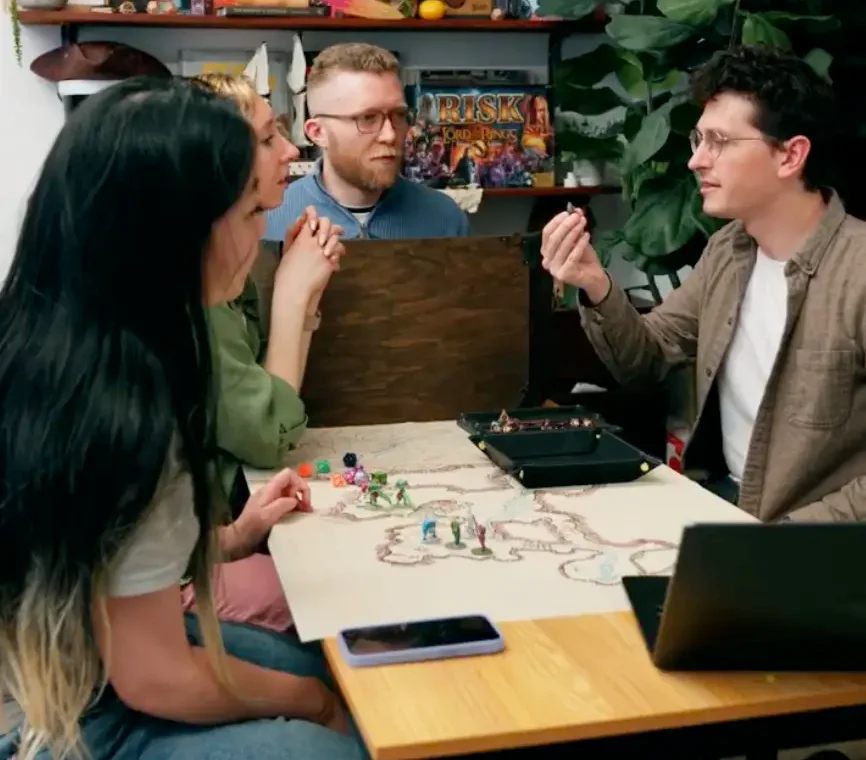
In the time since I wrote the script for our video with these tips, I’ve very frequently come back to how online favorite DM, Brennan Lee Mulligan, describes his role as a DM as “not to have a story in mind for you to go on,” but “as improvising in reaction to the players with a bag full of lots and lots of storytelling tropes.” It makes me think of how DMing, in one sense, can be an excellent practice of relinquishing total control, even in a position often thought of as the one who must be in total command (after all, it has “master” in the name). To me, it is much more a practice of trust, even when my goal is to help delight and challenge my friends who come to my table as players. Mini-tangent aside, I think some of my personal anxieties around silence and dead air actually stem from a very similar place, and thus can be quelled by many similar tips as above. It is a magical experience to be trying to play cool while a camp/rest scene is going on and you have no idea where on the map the players will go next, only to look up and realize that they have spun up a deeply emotional, lengthy conversation between their characters all on their own. To trust that they have my back, and that what I was worried would devolve into an empty beat transformed into something even more beautiful than I could’ve planned for. So yeah, I guess the real solution to dead air was the friends we made along the way? But maybe there’s more to learn about the nature of our hobby from interrogating and thinking about these anxieties than we originally realized.
Until our next chapter,
Austin