Why So Many Dice: When to Roll
Hail Beautiful Bards! So recently, there was a moment in an episode from Critical Role season 4, in which your favorite DM’s favorite DM Brennan Lee Mulligan abstained from calling for any sort of roll from players during their roleplaying on account of just how well they played the scene, described in this polygon article. And while I do believe that publications and the internet alike may have added a slightly superfluous gravity to the situation, it did prompt some conversations nonetheless. To be quite frank, I do not care to add any of my opinions to the pile of this piece of micro-zeitgeist. However, I do think that there is something at the core of this that I think of quite often, both as an active DM and as a game designer myself, which is:
When and Why do we roll the dice?
So, I reached out to our lovely discord community, as well as consulting a great deal of tomes and theories across the vast seas and surf of the internet, in order to come up with some of my favorite use-cases and reasons for when and when not to call for a roll. My hope is that there may be something in here to spark some thinking for your own games, whether you are brand new or highly leveled as a DM.
Uncertainty
It’s not too difficult to imagine a quick baseline understanding of what dice are for: randomness! Dice are analog RNG (random number generation just in case), and as we play games and tell stories that we don’t want to be entirely predetermined, dice are a quick way to resolve unanswered questions. The most common response I saw from the DMs in our discord was you call for a roll “when the outcome of an action is uncertain.” This aligns quite well as a textbook answer, considering on page 236 of the base 5e DMG, the second line of the section entitled “The Roll of Dice,” reads that dice “can determine the outcome of an action without assigning any motivation to the DM and without playing favorites.” But this leads me to my first issue of how people actually engage with dice. In the first line, just before the above quote, the section opens with a plain “dice are neutral arbiters.”
Now, I’m fully aware that I play with groups of freaks and weirdos, but considering my audience, there’s probably a good chance that you, too, play with freaks and weirdos. Therefore, I don’t think it’s too far out of the question to bring up the observation that, to many players, the dice are anything but neutral. Before sessions even begin, players practice their rolls to see which dice are “hot”. When the dice do well, we cheer, and in some cases, literally thank the dice. When they do poorly, we jail them or put them away, not to be rolled again for the rest of the session. I’d wager that there is an incredibly high likelihood that you have at least one dice goblin at your table who has more sets of dice than they could ever use in one session, maybe in part because of this exact phenomenon.

The Locked Door Problem
In my experience, the dice will take every opportunity they can to embarrass you. To bring it back to thinking of how and why we use dice, this also leads me to one of the most common issues with dice rolls: the Locked Door Problem. This describes a situation where a failed roll serves to block progression and/or crucial details needed to move a session forward, named for a hypothetical where a check is called to open a locked door to continue moving through a dungeon without alternative methods to get around. And while it would be easy to point to this as an example solved by simply not putting players in that position, before we rush to call it a “skill issue,” it’s important to realize how commonly it can appear, and also that it shows us one of the downsides of dice.
A lesson I think that most DMs eventually learn, often through a rather rocky process, is that, like I described in the last section, fairness itself does not directly translate to fun. Similarly, if I may be so bold, I think another important realization taken for granted is that while we play games for the pleasure of indeterminate outcomes and surprises, we still have goals and desire for resolution. Moreover, randomness is a tool of uncertainty, the two are not synonyms. Paraphrasing a lesson from my time in game design school: we can’t forget that while we have a number of tools to add depth and complexity to systems (like dice), the most complex and uncertain system we interact with is the human brain, and the act of putting multiple together results in unwritten results by nature. In contrast, randomness without meaning feels mechanical, and can result in players feeling a lack of agency over their outcomes.
Oracles of Fate
That being said, it would be foolish to throw the baby out with the bathwater or the dice out with the dice tray. One word that came up a few times in our community that I found distinct from uncertainty or randomness was “chaos.” To me, chaos has a deeper implication: that it automatically comes with some meaning. A beautiful connection between our modern use of dice to steer make-believe stories and their origins as rolling bones to divine the favor of the gods. Chaos has an energy to it, and carries with it the fear in the eyes of players seeing their DM roll behind the screen for “no reason.” I think of using dice in this way as mechanically adding a key ingredient to any story: tension. Let’s put a pin in that.
I find quite a bit of beauty in the idea that dice, having origins as bones rolled to determine divine favor or warn us of the future, are still used today for our entertainment in the same manner. We put the fate of these characters, who we are attached to so intimately, in the rolls of these magic rocks, gambling at their stories. Similarly, we use them as tools to tell us the results of our simulations: I do not swing the sword at my D&D table, so I must listen to the bones. We garner our own augury for the parts of the game that we do not perform, to hear from the dice gods. To use more game designer-y jargon: this abstraction of systems is an essential part of our games, and in some way leaves room for our imagination to respond to the dice.
Filling the Blank
Another truth of dice and DM’ing is that sometimes we don’t know. At least a few of our community members brought up that they call for dice rolls when they simply don’t have an answer for what would happen (again, oracles of fate). To take it back to the sword example, I know maybe slightly more than the average citizen does about swords, but I’m no expert; and again, active combat is strongly discouraged at my table. Luckily for me, despite the overwhelmingly many factors that could go into determining the effectiveness of the strike of a blade, I play a game where I am able to take all of that and abstract it into one or more rolls of a die, often accompanied with light narration in response to said rolls. In this case, I am entrusting the dice to cover the gaps in the theater of the mind, to fill in the blank.
This reminds me of Scott McCloud’s concept of “closure.” While originally written to describe the flow of time in between frames (known as the gutter) of a comic, it is also applicable to games, described in this article in relation to video games specifically (in my view, this is even more applicable to TTRPG’s, especially the more “theater of the mind” the play). To McCloud, closure is the “phenomenon of observing the parts, but perceiving the whole.” Often when we roll a die, we are smoothing over “the parts” of a scene or action to quickly come to an agreement on “the whole” of its result. Sometimes, we don’t need the entirety of detail to be described. This can extend to conversation as well: even though hypothetically you always have the ability to carry one out to its extent at the table, many DM’s are wise enough to know that not all conversations are created equally in the eyes of good narrative, and also that not all players (or DM’s) are in the same boat for how much they want to commit to pure roleplay.
Scene Partner
Now, I’ll be completely transparent about my playstyle and the amazing group that I play with: First and foremost, I am a narrative-loving, improv-heavy, filthy storygamer. Luckily enough, the players I play with have known each other for quite some time, and also several of them are professional actors and performers. And while I know that the majority of groups may look quite different than mine (and I also don’t think that the professionalization of these skills is necessary for play and I will write more about that in the future), this experience has nonetheless shaped how I’ve come to think about games and how we use the dice at our table. Again, even with an incredibly high level of willingness to dive into character, we certainly do not play out the entirety of every conversation. In fact, I’ve come to realize that in actuality, adding in rolls proves to be a great tool to play off of, to drive unique choices.
In the era of mass actual play consumption, it may be less revolutionary to conceive, but TTRPG role play and long form improv actually have quite a bit in common. I think plenty of people now recognize the quality of certain collaborative improv techniques in role play itself: continuing momentum with “yes, and” or “no, but,” reaching out to include or invite another player into a scene, or even just remaining flexible on ideas and possible directions. To go further than the conversation, though, I’ve actually begun thinking of the dice themselves as being additional entities in this improv conversation. There are systems that I think kind of try to build this in, such as the Hope and Fear mitigation systems of Daggerheart, or the mixed successes of PbTA games. In this type of play, the dice are there to shout “new choice” or even “yes, but” at any given time, keeping the story and the players on our toes.
Oh, the Drama
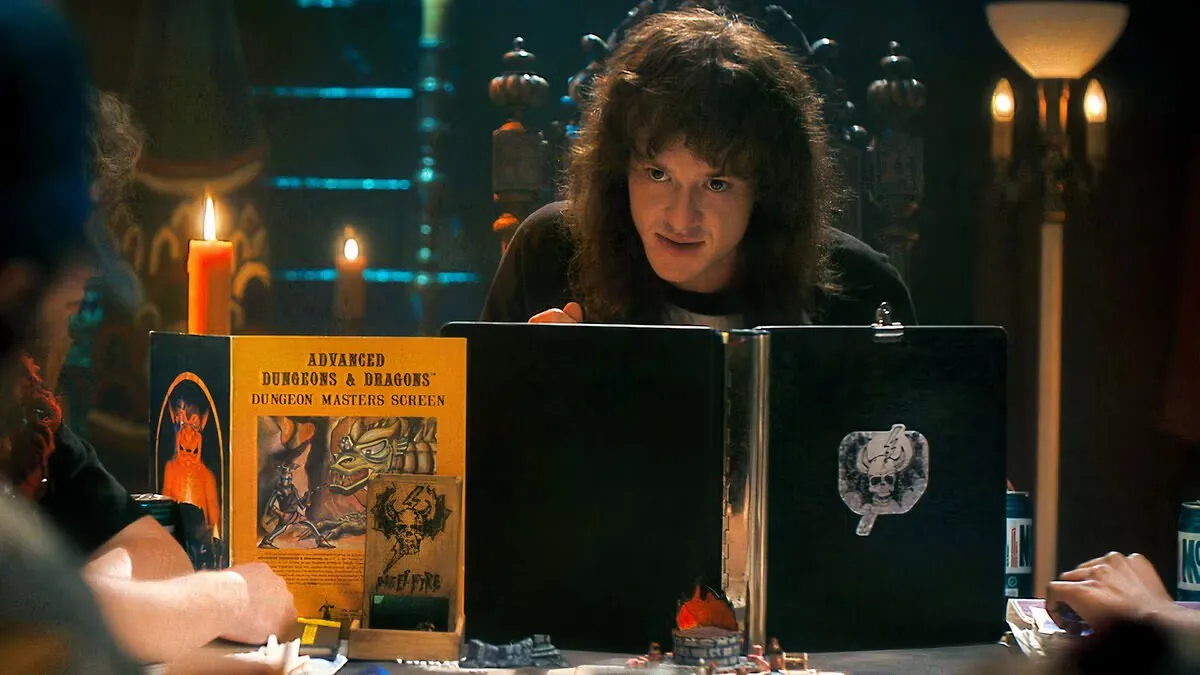
Now, with all of this improv talk, there may be a sense that this methodology is somewhat light-hearted or in jest, best used in moments of spontaneity or humor. But we know better: we know that one of the biggest staples of the hobby, one the most frequently discussed and documented canon events of the game, is the final roll. The roll that feels like life and death, the roll that brings the boss to die (still workshopping that pun), the roll that has everyone on their feet, holding their breath, waiting, like in the scene pictured above. A hobby that can be so whacky, so inside-joke-inducing, also has the ability to swing to deeply emotional, fully invested, life changing scenes, all driven by the same dice. There is a great deal of drama to the right roll, which is why we will finally take down that pin from earlier, and end with a note on tension.
While I find most universal theories on narrative, the type that say that all stories must contain [insert writer guru advice], inevitably fall flat, full of holes and lacking imagination, I do find that tension is a really great central driver for stories, maybe especially when the stories are told as a collaboration of multiple people. The roll of the die has a somewhat built in tension and release, but the release itself can also heighten the original tension further, which is quite exciting. I think tension is also the underlying driver of the above techniques and ideas, since they all have to do with driving a story forward in one way or another. The dice have a certain gravity to them, pulling you closer and closer to whatever is next. With that, I’m off to go plan for my dice rolls in my next session, but I hope that something in this post has helped you further your ideas about when you use dice, and how you can weaponize their inherent tension, their built-in chaos. Treat them well, use them wisely, and honestly they will probably not treat you well back, but maybe that’s the point.
Until our next chapter,
Austin